Geofisika & Geohazard
Cable Burial Risk Assessment: Why Deeper Isn't Always the Answer
The instinct behind protecting a submarine power cable seems obvious: bury it deep enough and nothing on the surface can reach it. In practice, burying every metre of an offshore wind farm's export cable to a uniform, conservative depth is neither affordable nor necessary — and it still might not be deep enough where it actually matters. Cable Burial Risk Assessment (CBRA) exists to replace that guesswork with a route-by-route, hazard-by-hazard specification of exactly how deep is deep enough.
The Standard the Industry Actually Uses
The Carbon Trust published the methodology that underpins most modern CBRA work in 2015, in a report titled "Cable Burial Risk Assessment Methodology: Guidance for the Preparation of Cable Burial Depth of Lowering Specification." It has since been cited and adopted by bodies including the U.S. Bureau of Ocean Energy Management, the Business Network for Offshore Wind, and Marine Scotland, making it the closest thing offshore wind currently has to a common standard for turning seabed hazard data into an actual burial depth number — the Depth of Lowering, or DoL — for each section of a cable route.
Why the Seabed Itself Is a Moving Target
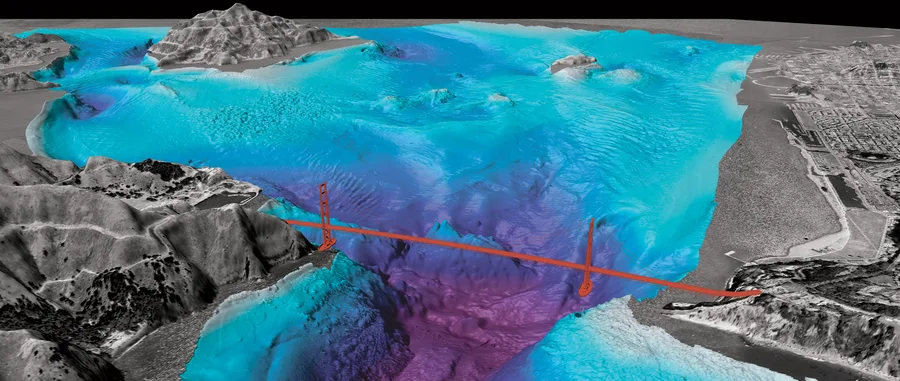
A CBRA doesn't treat the seabed as a fixed surface. Analysts assess local seabed mobility — currents, wave energy, sediment composition, and mobile bedforms such as sand waves and sandbanks — because a cable buried to a depth that looks adequate on the day of installation can be exposed years later if the sediment above it migrates or scours away. To manage that uncertainty, CBRA methodology uses the concept of a Reference Seabed Level (RSBL): a conservative, non-mobile reference depth that the seabed is judged unlikely to fall below for the lifetime of the wind farm, derived by comparing multiple geophysical survey datasets against metocean and sediment mobility data rather than trusting a single bathymetric snapshot.
The Threat That Actually Drives the Depth Number
Seabed mobility sets the reference depth, but it is external interference — not the seabed itself — that usually decides how deep a cable needs to sit. Ship anchors are treated as the primary threat in CBRA because they carry the greatest seabed penetration potential of any commonly encountered hazard, and industry-wide statistics from the International Cable Protection Committee attribute roughly 70 percent of submarine cable faults globally to accidental damage from fishing gear and anchors — far ahead of natural hazards or equipment failure. CBRA estimates anchor penetration as a multiplier of the anchor's fluke length: a factor of around 1 in sands and stiff clays, but a factor of 3 to 5 in soft clays, where an anchor can dig disproportionately deeper before it stops. Historically, a flat 0.6-metre burial depth was often used as a generic standard for protection against fishing gear — a figure CBRA replaced with a route-specific number that reflects what the seabed and the shipping and fishing activity at that exact location actually justify.
Where the Method Is Still Being Tested
CBRA is a live methodology, not a finished one. The anchor penetration factors most projects still use trace back to generic references from 1997 and earlier, and recent centrifuge testing suggests actual anchor penetration decreases as drag rate increases, and that real anchor orientation on the seabed doesn't always match the assumptions built into the current penetration factors — meaning the soil penetration factors that decide DoL specifications across the industry are due an update as better physical testing data becomes available.
Matching the Depth to the Actual Risk
A CBRA is ultimately an argument, built from survey data, for why a cable is safe at the depth specified — not deeper, not shallower, but exactly as deep as the surveyed combination of seabed mobility and external threat requires along that specific stretch of route. Getting that argument wrong in either direction has a cost: too shallow, and a dragged anchor or a migrating sand wave eventually finds the cable; too deep everywhere, and an offshore wind project pays for installation depth it never needed.
References
- The Carbon Trust, "Cable Burial Risk Assessment (CBRA) Guidance," https://www.carbontrust.com/our-work-and-impact/guides-reports-and-tools/cable-burial-risk-assessment-cbra-guidance
- The Carbon Trust, "Cable Burial Risk Assessment Methodology: Guidance for the Preparation of Cable Burial Depth of Lowering Specification" (2015), https://ctprodstorageaccountp.blob.core.windows.net/prod-drupal-files/documents/resource/public/cable-burial-risk-assessment-guidance.pdf
- Cathie, "An Overview of Cable Burial Risk Assessment Methods," https://cathiegroup.com/article/an-overview-of-cable-burial-risk-assessment-methods/
- Cathie, "Defining Acceptable Subsea Cable Risk," https://cathiegroup.com/article/defining-acceptable-subsea-cable-risk/
- Seagard, "Cable Burial Risk Assessment: An Integral Part of A Complete Risk Mitigation Strategy," https://www.seagard.org/news/cable-burial-risk-assessment-integral-part-complete-risk-mitigation-strategy
- International Cable Protection Committee (ICPC), "Damage to Submarine Cables from Dragged Anchors," https://www.iscpc.org/publications/icpc-viewpoints/damage-to-submarine-cables-from-dragged-anchors/
- U.S. Geological Survey (USGS), "Multibeam Bathymetry of San Francisco Bay," https://www.usgs.gov/media/images/multibeam-bathymetry-san-francisco-bay
Related Articles