Geophysics & Geohazard
Parametric, Chirp, Boomer, or Sparker: Choosing a Sub-Bottom Profiler Source
An earlier article on this site introduced the sub-bottom profiler as a single family of instrument, built around the same reflection principle as a fathometer but tuned to see through the seafloor rather than just to it. In practice, that family splits into four genuinely different acoustic sources — chirp, boomer, sparker, and parametric — and the one a survey ends up using rarely comes down to preference. It comes down to a fairly hard trade-off between resolution, penetration, and how much of the acquired data survives the trip to a clean, interpretable section.
Four Sources, Four Physical Principles
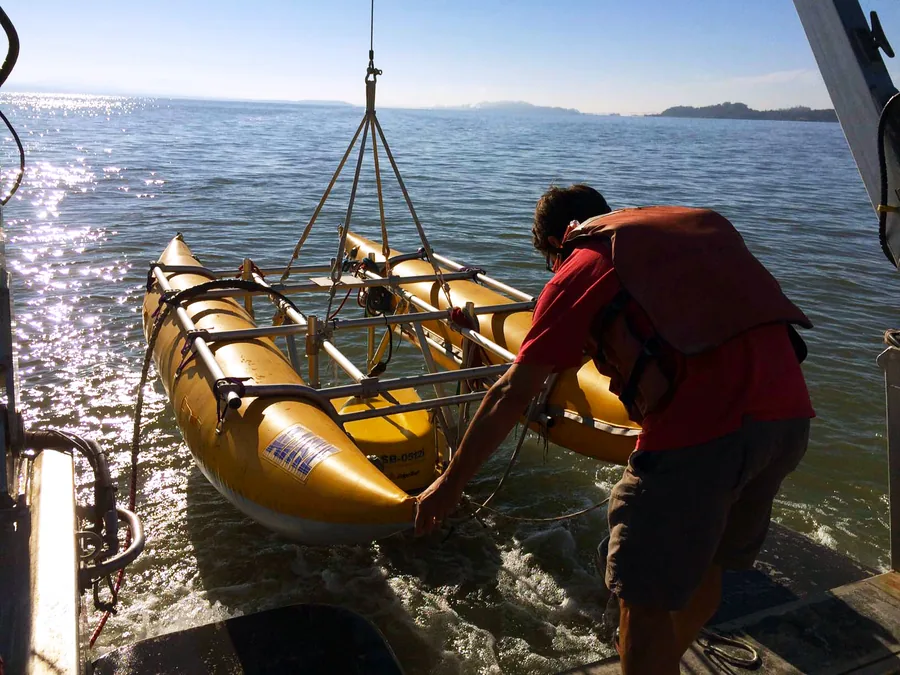
Chirp systems transmit an electronically swept frequency signal, typically ranging somewhere between about 2 and 16 kHz depending on the model, and use signal processing (pulse compression) to recover fine vertical resolution from that swept pulse. Boomer systems are electromechanical: a metal plate is driven apart from a coil by an electrical pulse, generating a broadband, lower-frequency signal usually concentrated between roughly 500 Hz and 5 kHz. Sparker systems generate sound electrically rather than mechanically — a high-voltage discharge across an array of electrodes vaporises the surrounding seawater, and the resulting pressure wave carries considerably more energy than a boomer's. Parametric systems work through a different physical mechanism entirely: two high-frequency primary signals, transmitted simultaneously and close together in frequency, interact nonlinearly in the water column itself to generate a much lower-frequency secondary signal — the difference frequency — inside a narrow, non-diverging beam.
Resolution vs. Penetration
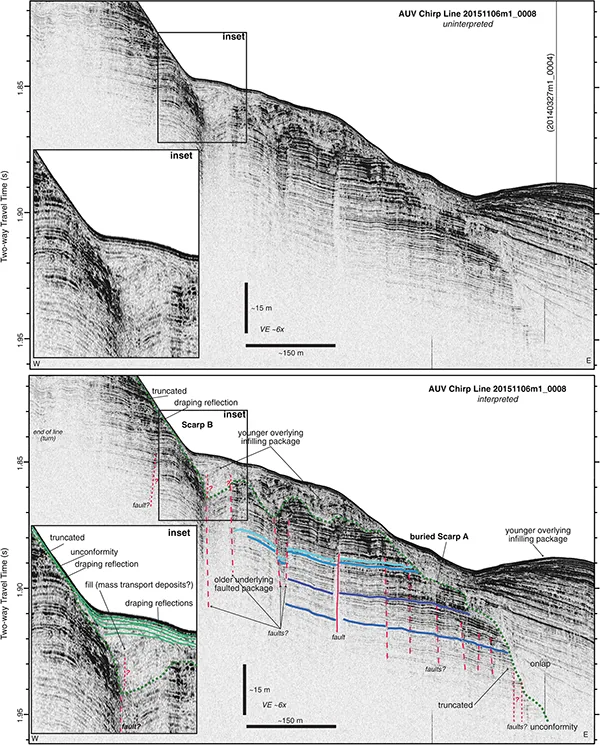
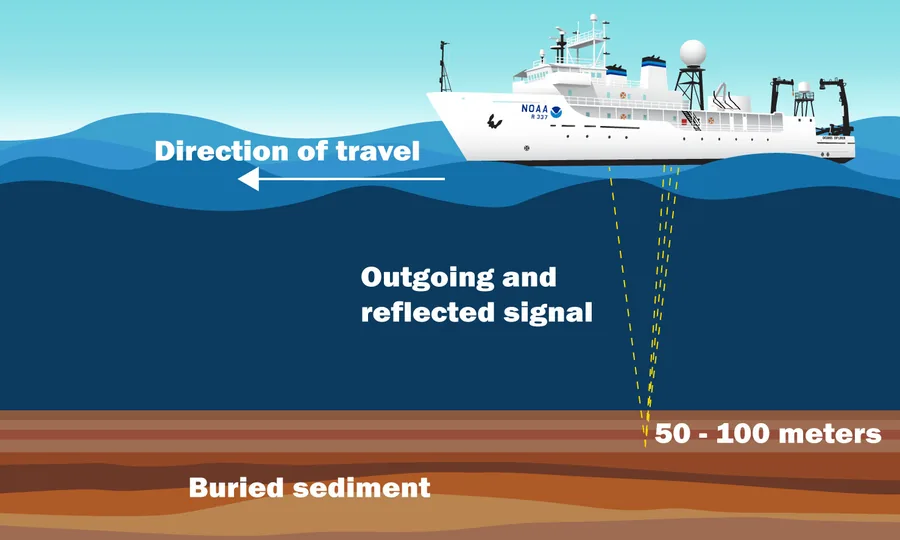
Of the four, chirp gives the sharpest imaging of the uppermost sediment layers but does not push as deep into the sub-bottom as boomer or sparker sources. Boomer systems, working at lower frequency, penetrate substantially further — up to around 100 metres in favourable sediment — at the cost of coarser vertical resolution. Sparker systems, with the highest source energy of the four, generally offer the greatest raw penetration of all, again trading away some resolution to get there. Parametric systems occupy an unusual position in that trade-off: because the secondary difference-frequency signal is generated in a very narrow beam with no side lobes, a parametric system routinely delivers the finest vertical resolution of the group while still reaching penetration depths that compete with chirp and, in many sediment types, boomer.
The Physics Behind Parametric — and Why It Took Decades to Commercialise
The underlying phenomenon was described by Peter Westervelt in 1963, who built the theoretical sound-field model for what became known as the parametric acoustic array — a discovery reportedly inspired by Westervelt noticing an unexpectedly strong, directional low-frequency sound coming off an 18 kHz underwater transducer while working at the Office of Naval Research years earlier. Berktay later extended Westervelt's theory specifically toward underwater sound transmission, and the parametric array went on to underpin not just sub-bottom profiling but underwater communication and buried-object detection more broadly. It took until the early 2000s for the technique to reach the market as a compact, commercially practical sub-bottom profiler — Innomar's SES-2000 compact launched in 2002, with newer generations following roughly every decade since.
Why Parametric Data Needs Less Cleanup
A 2024 comparative study processing pinger, chirp, boomer, and parametric sub-bottom profiler datasets side by side found that each source type demanded a different processing workflow before it was interpretable. Boomer data needed band-pass filtering to remove swell noise and predictive deconvolution to suppress multiple reflections. Chirp data benefited most from spiking deconvolution to tame its characteristically "ringy" waveform character. The parametric dataset, by contrast, required the fewest processing steps of the four and showed the highest vertical resolution once wavelength was calculated from the spectral data — a direct consequence of the narrow, side-lobe-free beam the nonlinear mixing process produces, which leaves far less multiple-reflection and reverberation noise for post-processing to clean up in the first place.
Matching the Source to the Job
In practice, the choice still tracks the objective rather than any single system's superiority. A shallow habitat or cable-burial survey where centimetre-scale layering in the top few metres matters most is chirp territory. A geohazard or geotechnical site investigation needing tens of metres of penetration through variable sediment, on a moderate budget, still commonly reaches for boomer or sparker. Where the project can justify the equipment cost and needs both fine resolution and solid penetration in the same pass — engineering surveys ahead of offshore wind foundations being a common case — parametric increasingly wins on total time-to-interpretable-data, precisely because so much less processing stands between raw acquisition and a usable section.
References
- Nasif, A. et al., "Processing of pinger, Chirp, boomer, and parametric subbottom profiler datasets," Turkish Journal of Earth Sciences, https://journals.tubitak.gov.tr/earth/vol33/iss7/4/
- Applied Acoustics, "Guide to Sub-Bottom Profiling," https://www.appliedacoustics.com/news/guide-to-sub-bottom-profiling/
- Unique Group, "Understanding Sub-Bottom Profilers and Their Applications," https://www.uniquegroup.com/media-centre/blog-articles/understanding-sub-bottom-profilers-and-their-applications/
- Innomar Technologie GmbH, "Parametric Sub-Bottom Profilers," https://www.innomar.com/innomar-home
- Delft University of Technology, "Parametric Echosounder," https://www.tudelft.nl/en/ceg/about-faculty/departments/geoscience-engineering/laboratory/facilities/parametric-echosounder
- Zhang, Y. et al., "Parametric Acoustic Array and Its Application in Underwater Acoustic Engineering," Sensors 20(7), 2148, https://pmc.ncbi.nlm.nih.gov/articles/PMC7180615/
Related Articles
Applications of Sub-Bottom Profilers: Revealing What Lies Beneath the Seafloor
Multichannel Seismic Reflection in Practice: The Coelacanth Discovery in the Gulf of Mexico