Marine Survey Technology
ROV Inspection: The Practical Workhorse of Offshore Asset Integrity
Autonomous underwater vehicles, covered elsewhere on this site, are built to survey wide areas without a tether. ROV inspection solves a different, more everyday problem: looking closely and repeatedly at one specific structure — a platform jacket, a pipeline, a mooring chain — that an operator already knows the location of and needs to check on a schedule. It is unglamorous, high-frequency work, and it is the backbone of how offshore asset integrity actually gets verified.
Matching the Vehicle to the Depth and the Job
ROVs used for inspection split broadly into two classes. Observation-class ROVs are built for shallower work, generally rated to around 300 metres, and are comparatively inexpensive — typically in the range of $10,000 to $100,000 — making them the economical choice for pipelines and structures at depths of around 300 metres or less. Work-class ROVs sit at the other end of the scale, rated from roughly 3,000 up to 6,000 metres, built to carry manipulator arms and heavier tooling, and serving as the standard platform for deepwater inspection that neither divers nor smaller vehicles can reach. Between the two, light work-class ROVs rated to around 1,000 metres offer a middle ground of moderate payload capacity for jobs that don't need full work-class power.
How an Inspection Actually Escalates
Most ROV inspection work follows a staged escalation rather than a single fixed procedure. General Visual Inspection (GVI), typically HD video from an observation-class ROV, confirms baseline conditions — route, burial status, free spans, crossings, and support conditions along a pipeline or structure. Where GVI flags something worth a closer look, Close Visual Inspection (CVI) follows, using pan-tilt-zoom camera control to examine the specific feature in detail. If CVI still leaves the condition of the material itself in question, the inspection escalates again to non-destructive testing: alternating current field measurement (ACFM) and pulsed eddy current (PEC) for crack and corrosion detection through coatings, phased array ultrasonic testing (PAUT) or long-range ultrasonic testing (LRUT) for wall thickness, and C-scan corrosion mapping for a full picture of metal loss across a feature like a J-tube. This staged approach is also how ROVs support formal Class inspections of mobile offshore drilling units, FPSOs, FSOs, and platform jacket structures, where classification societies require documented, escalating levels of evidence rather than a single visual pass.
Case in Point: 2,340 Kilometres of Pipeline in Under Ten Months
A Gulf of Mexico inspection campaign illustrates what routine ROV pipeline inspection looks like at scale: 261 pipelines totalling 2,340 kilometres across four fields, at depths ranging from 15 to 130 metres, completed in under ten months. The campaign averaged roughly 8 kilometres of pipeline inspected per day of production — a strong throughput figure for the majority of the pipelines surveyed — and ran with no significant equipment downtime and zero lost-time incidents. Numbers like these are the real measure of an ROV inspection programme's value: not the sophistication of any single dive, but the ability to sustain that throughput, safely, across hundreds of kilometres and multiple fields without interruption.
Case in Point: Nesting a Smaller ROV Inside a Larger One
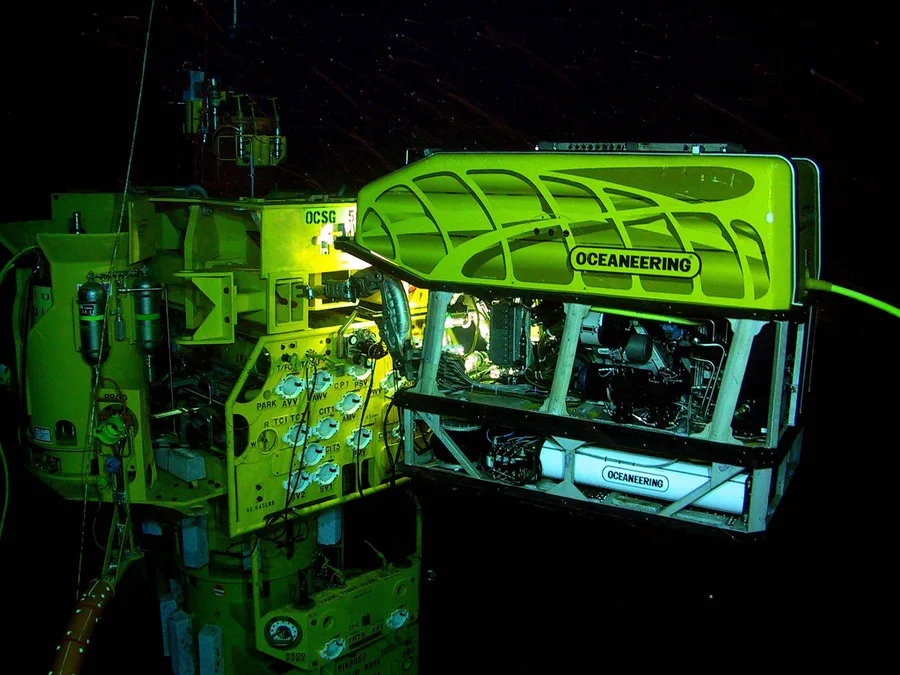
Some inspection targets are physically too confined for even a compact work-class ROV to reach directly, which has led to hybrid deployment strategies: using a larger work-class ROV purely as a transport and stabilisation platform, carrying a smaller inspection-class vehicle down through the splash zone and rough near-surface sea states, then releasing it to manoeuvre into confined subsea pipeline sections the host vehicle itself could never enter. The approach solves two separate problems at once — the host ROV's size and power handle the difficult transit through turbulent shallow water, while the smaller vehicle's size handles the physically tight inspection target once it arrives.
The Value Is in the Repetition, Not the Novelty
Nothing about a routine ROV inspection dive is experimental — the vehicles, the camera work, and the escalation from GVI to CVI to NDT are all mature, standardised procedures. That maturity is precisely the point: offshore asset integrity depends on the same structures being checked the same way, on a predictable schedule, for decades. ROV inspection's real contribution isn't a single dramatic discovery — it's the unglamorous, repeatable throughput that keeps thousands of kilometres of pipeline and hundreds of platform structures under continuous, documented watch.
References
- ACSM Ships, "Pipeline ROV Inspection in Mexico," https://acsmships.com/case-studies/pipeline-rov-inspection-in-mexico/
- Rigzone, "How to Conduct an NDT Inspection on Offshore Pipelines," https://www.rigzone.com/insights/operational-questions-8/how-to-conduct-an-ndt-inspection-on-offshore-pipelines-931/
- Deep Trekker, "Innovative Offshore Pipeline Surveys with Integrated ROVs," https://www.deeptrekker.com/resources/work-class-rov-hosts-pivot-rov-for-high-precision-offshore-inspections
- Deep Trekker, "Underwater ROVs: Uses and Industry Applications," https://www.deeptrekker.com/resources/underwater-rovs
- Subsea 7, IRM Case Studies, https://irm.subsea7.com/projects
Related Articles