Marine Survey Technology
Acoustic Doppler Current Profiler: Measuring Currents Instead of Depth
An echosounder listens for a hard reflection off the seafloor and times how long it took to get there. An Acoustic Doppler Current Profiler sends out the same kind of sound pulse but is listening for something completely different: not a single sharp echo from a solid boundary, but a faint, continuous scatter of returns from the countless small particles and plankton drifting through the water column, each one Doppler-shifted by however fast it happens to be moving. From that shift, an ADCP reconstructs not where the seafloor is, but how fast the water itself is moving, and in which direction, at every depth along its beam.
How an ADCP Measures Current Instead of Depth
The physics an ADCP relies on is the same Doppler effect that makes a passing ambulance siren change pitch: sound reflected off something moving toward the source comes back at a slightly higher frequency, and sound reflected off something moving away comes back slightly lower. An ADCP transmits a steady "ping" and listens for the scattered return from suspended particles and zooplankton that, on average, drift at the same speed and direction as the water carrying them — the instrument isn't detecting the particles themselves so much as using them as tracers for the water's motion. Because it can also time how long each portion of the return took to arrive, it can sort those returns into a series of depth bins along the beam, producing not a single current reading but a full vertical profile of current speed and direction from near the transducer down to wherever the signal remains usable.
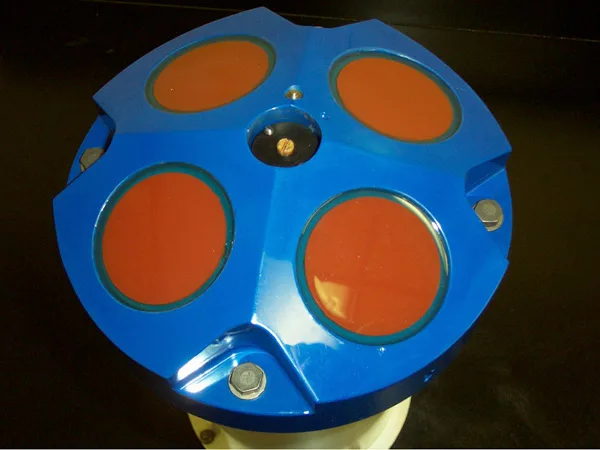
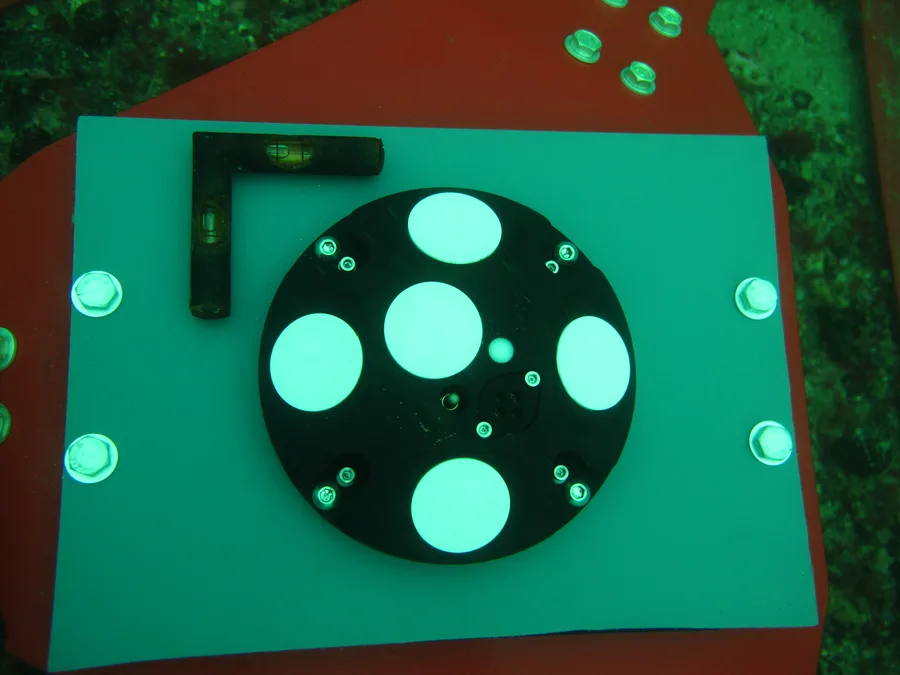
A single beam only measures the water's velocity component along that one line of sight, which isn't enough to describe a genuine three-dimensional current. ADCPs solve this with multiple transducer beams — commonly four, angled outward from the vertical in what's often called a Janus configuration — so that combining the along-beam velocity from each one mathematically reconstructs the full horizontal and vertical velocity vector at each depth bin. A four-beam layout also gives the instrument a built-in error check: if the beams don't agree with each other the way simple geometry says they should, that mismatch signals turbulence, an obstruction, or bad data rather than being silently averaged away.
A Short History
RD Instruments, the company whose name gave the ADCP its now-generic abbreviation, was founded in 1981 by Fran Rowe and Kent Deines. The company produced its first ADCP the following year, a self-contained, battery-powered unit built for long-term unattended deployment, using a narrow-bandwidth, single-pulse method that was the first to deliver current measurements clean enough for serious oceanographic use. Nearly a decade later, in 1991, RDI began shipping its first production BroadBand ADCPs, a substantially more capable generation that improved on the original technique's precision. The underlying approach has been refined many times since, but the core Doppler-and-range-gating principle established in that first 1982 instrument is still what every modern ADCP does.
What ADCP Data Is Actually Used For
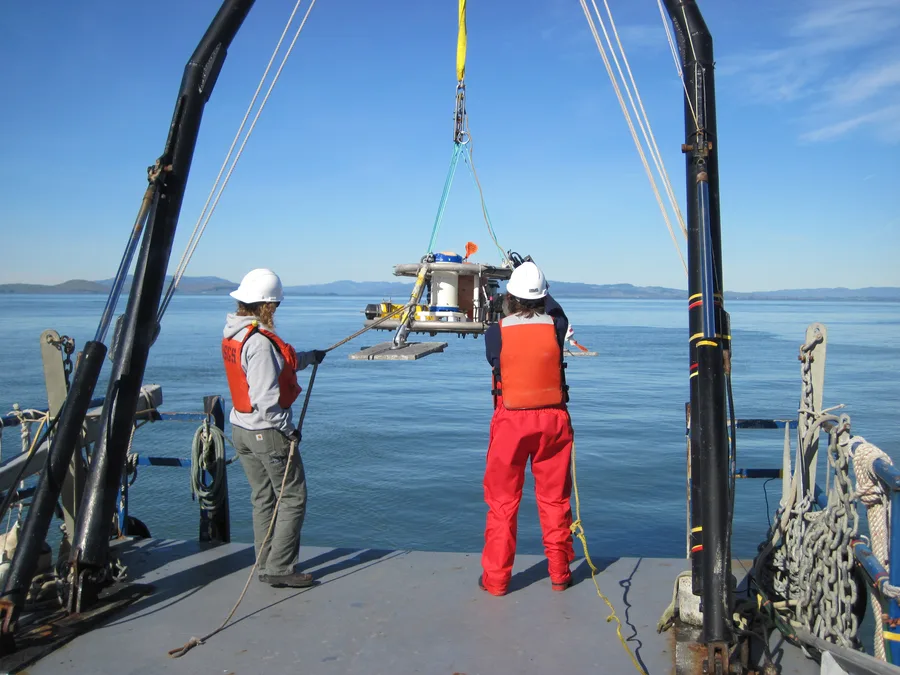
Port and harbor authorities rely on ADCP-derived current maps to lay out docks, channels, and breakwaters, since knowing how currents circulate at different tidal stages is central to keeping large vessels moving safely in and out of a harbor. In open coastal and estuarine settings, ADCPs are the standard tool for tidal current studies and for the sediment transport assessments that inform beach nourishment projects and shoreline protection design, since the same current data that describes water movement also underpins estimates of how much suspended sediment that water is carrying and where it will end up. In river and stream hydrology, an ADCP mounted on a small boat or towed on a catamaran can measure streamflow directly across a channel cross-section, replacing much slower manual current-meter methods.
A quieter but equally practical use is navigational rather than scientific: an ADCP's "bottom tracking" mode uses the same Doppler principle against the seafloor itself, rather than midwater particles, to measure a vessel's speed and direction relative to the bottom — a technique useful as a positioning and dead-reckoning aid in situations where GNSS signal quality is degraded.
Conclusion
Everything an ADCP does traces back to the same trick: letting particles that are already moving with the water tell on themselves through a frequency shift, then sorting the returning echoes by arrival time to build a full vertical profile instead of a single number. It's a modest-sounding piece of physics for an instrument that quietly underwrites how ports get designed, how sediment gets tracked, and how well a survey vessel knows its own speed when nothing else will tell it.
References
- Teledyne RD Instruments — Acoustic Doppler Current Profiler Principles of Operation: A Practical Primer
- Wikipedia — Acoustic Doppler Current Profiler
- Woods Hole Oceanographic Institution — Acoustic Doppler Current Profiler (ADCP)
- Hydro International — Sedimentation Estimation from ADCP Measurements
- U.S. Geological Survey — Use of an ADCP to Compute Suspended-Sediment Discharge in the Tidal Hudson River, New York
- Wikimedia Commons — ADCP Head (WH-600); Deployment of Acoustic Doppler Current Profiler; Signature1000 ADCP
Related Articles