Marine Survey Technology
AUV Mission Planning: Budgeting Battery, Range, and Communication Before the Vehicle Ever Leaves the Deck
An AUV's survey capability, covered elsewhere on this site, is only ever as good as the mission plan that budgets its three hardest constraints in advance: how much energy it actually has, how it will report back without a live tether, and how it corrects its position without GPS for most of the mission. Get any one of those three wrong, and the vehicle either fails to complete its survey area or fails to be found again.
Endurance Is a Function of Vehicle Architecture, Not Just Battery Size
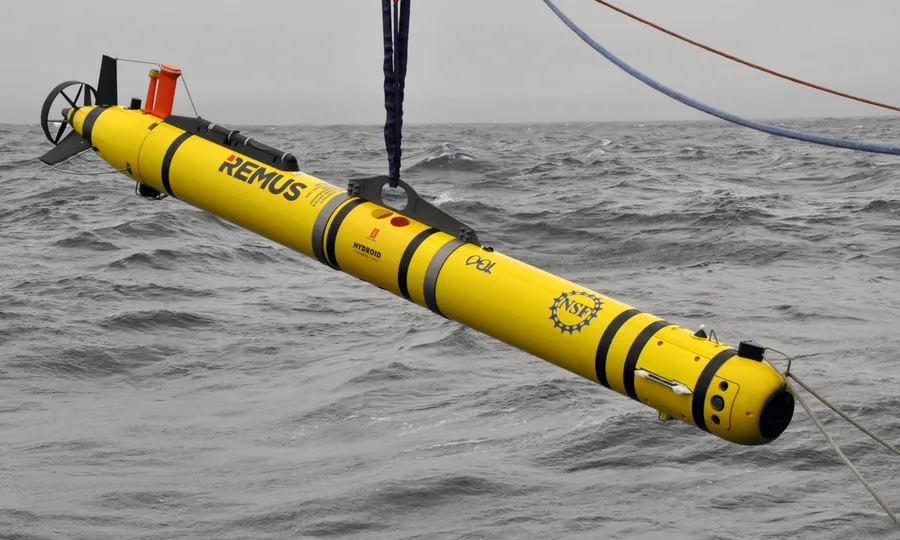
The bulk of an AUV's onboard energy budget goes to propulsion, and that budget is fixed by the physical volume the vehicle can dedicate to batteries — which is why endurance correlates so strongly with a vehicle's overall size and design philosophy rather than battery chemistry alone. A standard torpedo-style AUV like the Bluefin-21, running on lithium-ion batteries, is typically limited to around 25 hours of mission time. Long-range AUVs built specifically for endurance take a fundamentally different architectural approach and land in an entirely different category of mission length.
Case in Point: What Purpose-Built Endurance Actually Looks Like
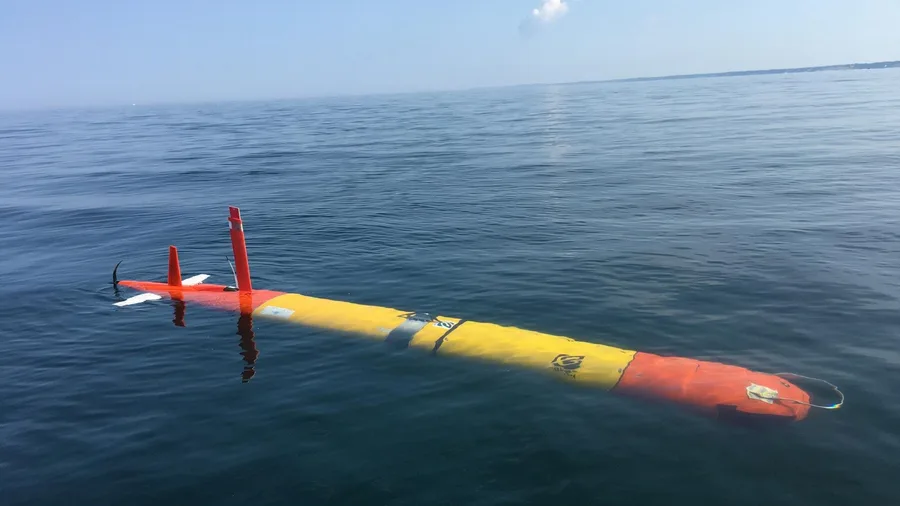
MBARI's Tethys-class long-range AUV (LRAUV) illustrates the gap: a torpedo-shaped vehicle 2.3 metres long and just 31 centimetres in diameter, weighing 110 kilograms, rated to dive to 1,500 metres, and capable of an endurance of 740 hours under a nominal payload — multiple weeks at sea depending on payload and cruising speed. Unlike a buoyancy-driven glider, Tethys uses a propeller for level, controlled flight across a speed range of 0.5 to 1.2 metres per second, and switches between low- and high-power operating modes depending on what a given phase of the mission actually requires. At a cruising speed of 0.75 metres per second, the platform has demonstrated a range of roughly 1,000 kilometres sustained for weeks at a time; with primary batteries at 1 metre per second, the projected ultimate range extends past 2,000 kilometres. The MBARI LRAUV fleet has logged more than 40,000 operational at-sea hours in total, and the programme passed its 150th completed mission — numbers that only make sense because the vehicle's entire design, not just its battery pack, was built around endurance from the outset.
Reporting Back Without a Tether
Because radio and GPS signals attenuate almost immediately in seawater, an AUV's only means of long-range communication while submerged is acoustic, and acoustic links trade range directly against bandwidth. The WHOI Micromodem, built for long-range links, tops out around 5,400 bits per second; move to a shorter 300-metre range and available bandwidth jumps to roughly 62.5 kilobits per second. Teledyne's Benthos telemetry modems reach up to 6 kilometres at low frequency, 4 kilometres at medium frequency, and 2 kilometres at their highest band, delivering around 15.36 kilobits per second — while wide-bandwidth acoustic systems can reach roughly 1 megabit per second, but only out to about 100 metres. A mission plan has to pick a point on that range-versus-bandwidth curve deliberately, matching the volume of data that actually needs to come back in near-real time against how far the vehicle will realistically be from a receiving node at the time it needs to send it.
Position correction follows the same underlying constraint. GPS is unavailable underwater for the same reason radio communication is limited, so AUVs on long-duration missions have to surface periodically specifically to obtain a GPS fix and correct the dead-reckoning drift accumulated while submerged — a navigation strategy that has to be built into the mission plan as a scheduled event, not an emergency fallback.
Replanning Mid-Mission When the Budget Runs Short
Because currents, salinity, and course corrections can all erode an energy budget in ways a pre-mission plan cannot fully anticipate, some AUVs now carry onboard mission-replanning logic that adjusts a survey pattern in flight based on energy actually remaining rather than energy originally budgeted. In one documented case using an onboard genetic-algorithm-based planning agent, a replanned survey mission achieved twice the area coverage of the original plan while operating on an energy budget that was itself half of what had originally been allocated — a demonstration that adaptive, energy-aware replanning can meaningfully outperform a fixed pre-mission plan when conditions on the day don't match the forecast.
The Plan Is the Mission, Not an Input to It
An AUV mission succeeds or fails largely on decisions made before the vehicle is ever in the water: how much endurance the chosen platform architecture actually provides, what data genuinely needs to come back acoustically versus what can wait for recovery, and when the vehicle will surface to fix its position. Treating those three constraints as fixed inputs to plan around, rather than problems to solve reactively once the vehicle is already submerged and out of contact, is what separates a completed survey from a vehicle that simply runs out of budget somewhere short of its target area.
References
- Monterey Bay Aquarium Research Institute (MBARI), "Long-Range AUV (LRAUV)," https://www.mbari.org/technology/long-range-auv-lrauv/
- MBARI, "Long-Range Autonomous Underwater Vehicle Completes 150th Mission," https://www.mbari.org/tethys150/
- Naval Technology, "Tethys-Class Long-Range Autonomous Underwater Vehicle (LRAUV), USA," https://www.naval-technology.com/projects/tethys-class-long-range-autonomous-underwater-vehicle-lrauv-usa/
- Seto, Y., "Application of On-Board Evolutionary Algorithms to Underwater Robots to Optimally Replan Missions with Energy Constraints," Journal of Robotics, https://hindawi.com/journals/jr/2012/542124
- "Performance Optimization of Underwater Communication Links at Different Ranges for AIS Relay to AUV," Applied Sciences (MDPI), https://www.mdpi.com/2076-3417/12/9/4166
Related Articles