Platform & Operasi Survei
Distributed Acoustic Sensing: Turning a Fiber-Optic Cable Into Thousands of Listening Posts
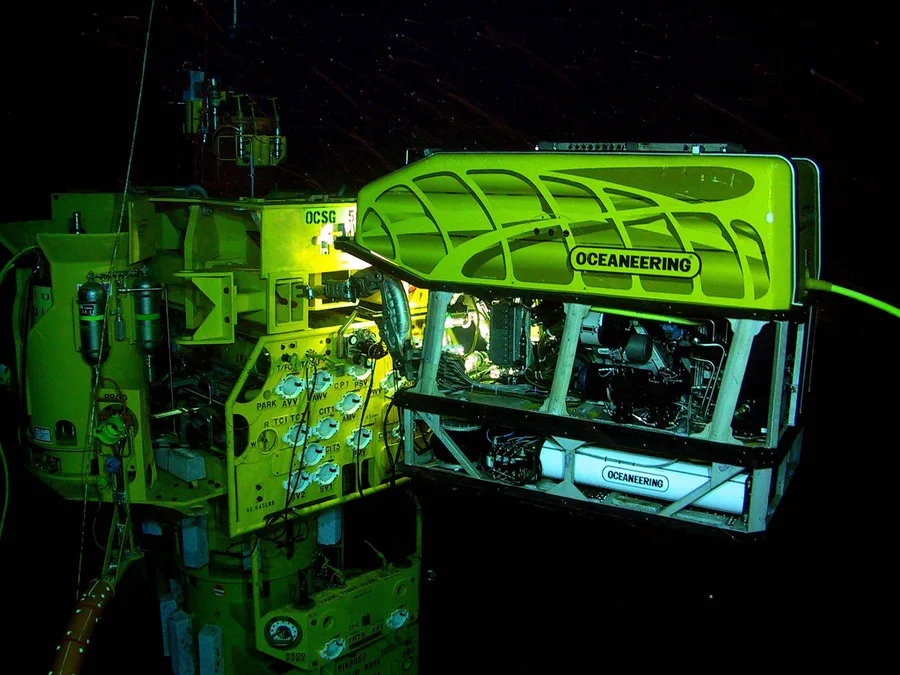
Our article on ROV inspection covers how offshore operators check on a pipeline or cable today: a vessel is mobilized, an ROV is launched, and a length of infrastructure is inspected — thoroughly, but as a snapshot, on whatever schedule the inspection program allows. Distributed acoustic sensing (DAS) answers a different question entirely. Instead of asking "what condition is this asset in today," it asks "is anything happening along this entire route right now" — turning a length of fiber-optic cable that was often installed purely for data transmission into a continuous acoustic sensor spanning its full length, listening in real time, all the time, with no separate sensors to deploy at all.

The Physics: Reading Backscattered Light, Not Adding Sensors
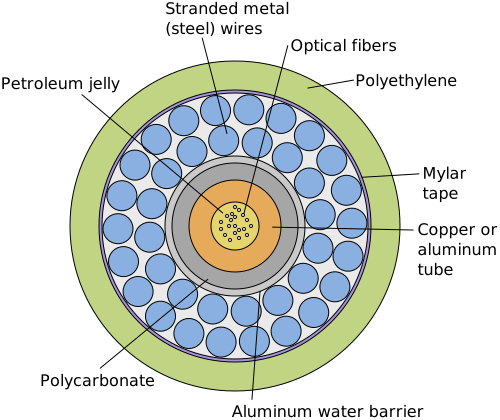
DAS does not require any electronics, sensors, or power along the length of cable being monitored — everything happens at one end, in a device called an interrogator. The interrogator fires short laser pulses down the optical fiber, thousands of times per second. As each pulse travels, a small fraction of its light is continuously scattered backward by microscopic, naturally occurring density variations in the glass itself — a well-understood phenomenon called Rayleigh backscatter, the same physical effect that has underpinned conventional optical time-domain reflectometry (OTDR) fiber-testing equipment since the 1980s. What makes DAS different from ordinary OTDR is that it uses a coherent, phase-sensitive variant of the technique — phase-sensitive OTDR, or φ-OTDR — which tracks not just the intensity of the returning backscatter but its phase. Any external disturbance that physically strains the fiber, whether from a vibration, an impact, or a pressure change, measurably shifts that phase at the exact point along the fiber where the disturbance occurred. Because the interrogator knows precisely how long it takes light to travel to any point on the fiber and back, it can convert the timing of a detected phase shift directly into a distance, effectively localizing the disturbance to a specific point along a cable that may run for tens or hundreds of kilometers — all from a single instrument at one end.
The interrogator's output is not one measurement but a dense grid of virtual sensors: current commercial systems typically resolve the fiber into channels spaced roughly every 10 metres (finer spacing, down to around 1 metre, has been demonstrated in specialized deployments), each independently sampled at rates commonly in the hundreds of hertz and up to several kilohertz in advanced configurations — fast enough to resolve genuinely acoustic-frequency signals, not just slow strain trends. A single interrogator can typically cover on the order of 50 kilometers of fiber, with demonstrated real-world deployments extending toward roughly 95 kilometers and specialized amplified research systems pushing coverage into the thousands of kilometers. The practical result is that a single instrument, plugged into one end of an existing fiber-optic cable, effectively becomes an unbroken line of acoustic sensors covering the cable's entire route — a sensor density that would be entirely impractical to achieve by installing discrete point sensors at similar intervals.
From Seismology Curiosity to Infrastructure-Protection Tool
DAS built on Rayleigh backscatter emerged from fiber-sensing research in the early 1990s, with foundational work credited to Dakin in 1990 and Taylor and Lee in 1993, but the technology most directly used for infrastructure monitoring today — phase-sensitive OTDR-based distributed vibration sensing — traces to a first working system introduced in 2005. From there, the application shifted gradually from a laboratory sensing technique toward practical infrastructure monitoring: onshore pipeline operators adopted it to detect third-party interference and leaks along buried pipeline corridors, and power utilities adopted it to detect unauthorized excavation near buried cables and to flag developing cable faults. The offshore and subsea extension of the same idea followed a similar logic once the amplification and processing needed to sense weaker signals over the longer, harsher paths of submarine cables matured — recognizing that any submarine telecommunications or power cable that already carries dark, unused fiber strands can, in principle, be turned into a monitoring sensor for its own route without laying a single additional sensor cable alongside it.
What DAS Actually Detects on a Subsea Route
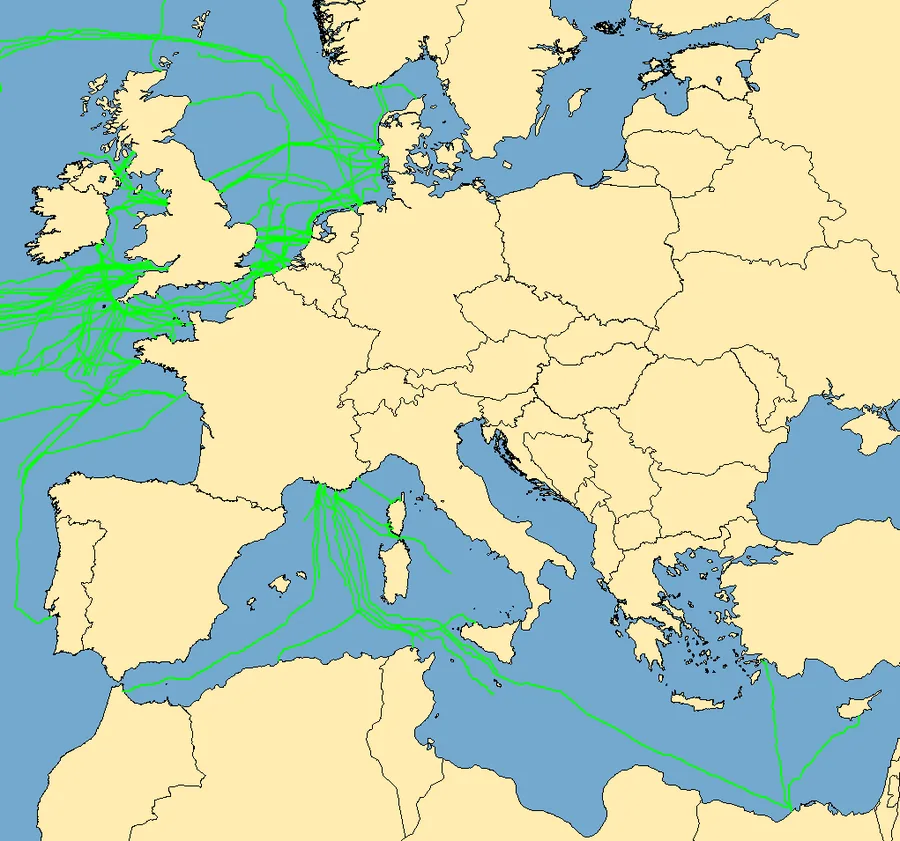
Applied to submarine cables specifically, DAS systems are tuned to recognize the acoustic and vibrational signatures of the events that most commonly threaten cable integrity: a dragging ship's anchor, a trawl net or ground gear scraping along the seabed near the cable, excavation or construction activity where a cable makes landfall, and the low-frequency vibration signatures produced by vessels transiting overhead — the latter application extending DAS beyond pure threat detection into broader maritime domain awareness, since the technique can register the presence, and in some cases the general character, of surface vessel traffic along the cable's entire route, effectively turning the cable into a passive vessel-detection line as a byproduct of its primary monitoring function.
Case Study: A Year of Watching 92 Kilometers of Subsea Telecom Cable
One of the clearest published demonstrations of DAS working as intended on submarine infrastructure is a long-term monitoring trial covering a 92-kilometer section of a subsea telecommunications cable, run continuously over a full year and presented at the 2022 Optical Fiber Sensors (OFS) conference. Real-time processing on that deployment successfully detected and flagged the two threat categories that dominate real-world submarine cable damage statistics: bottom-trawl fishing activity passing near the route, and ship anchoring events close enough to pose a risk of cable strike or drag damage. Sustaining that kind of detection performance continuously across nearly three-quarters of a full DAS interrogator's typical single-span range, for a full year without interruption, is itself evidence that the technology has moved well past a laboratory demonstration and into a genuinely operational monitoring tool — precisely because trawling and anchoring are, by wide margin, the two dominant real-world causes of submarine cable damage globally, which is exactly what a monitoring system protecting cable infrastructure most needs to catch.
The gap left by not having that kind of system in place became a matter of public record on September 26, 2022, when explosions ruptured the Nord Stream 1 and Nord Stream 2 gas pipelines under the Baltic Sea, first detected by seismometers on land in Denmark and Sweden rather than by any monitoring system on the pipelines themselves — because none of the kind existed on that infrastructure. In the aftermath, DAS vendors were direct about what the technology could plausibly have changed: as one industry sales executive put it publicly, had a DAS system been connected to the Nord Stream pipelines, "it would not have been possible to install explosive devices there without someone noticing." A separate, smaller incident a few months earlier — the January 2022 severing of a Norwegian fiber-optic cable connecting the Svalbard Satellite Station to mainland communications, the northernmost cable of its kind — underscored the same underlying gap in a different setting. Neither incident is a DAS case study in the sense of the 92-kilometer trial above; both are, instead, the reason that trial and others like it have moved from research curiosity to a live subject in subsea infrastructure security planning since 2022.
A Different Layer of Monitoring, Not a Replacement for the ROV
DAS does not replace physical inspection, and it is not designed to. It cannot tell an operator the corrosion state of a cable's armor wire, confirm burial depth against a design specification, or perform close-range visual or NDT inspection of a specific joint or repeater housing — all still work for an ROV, exactly as covered in our companion article on ROV inspection. What DAS adds is the layer that periodic inspection structurally cannot provide: continuous awareness of what is happening along the entire route, every hour of every day between inspection campaigns, catching the anchor drag or trawl pass at the moment it happens rather than discovering the resulting damage weeks or months later on the next scheduled survey. For an asset that is, by definition, kilometers long and largely invisible once it disappears beneath the waterline, that shift — from periodic snapshot to continuous listening — is less an incremental improvement than a genuinely different category of protection.
References
- NKT, "Distributed Acoustic Sensing (DAS) — Cable Monitoring Solutions," https://www.nkt.com/products-solutions/lifecycle-cable-services/cable-monitoring-solutions/offshore/distributed-acoustic-sensing-das
- AP Sensing, "Distributed Acoustic Sensing (DAS) | C-OTDR," https://www.apsensing.com/en/technology-and-products/distributed-acoustic-sensing
- AP Sensing, "Enhancing Subsea Infrastructure Monitoring with Fiber Optic Sensing," https://www.apsensing.com/en/news/news-enhancing-subsea-infrastructure-monitoring-with-fiber-optic-sensing
- Optica Publishing Group, "Experience from Long-term Monitoring of Subsea Cables using Distributed Acoustic Sensing," OFS 2022 conference paper, https://opg.optica.org/abstract.cfm?uri=OFS-2022-Th2.4
- arXiv, "Monitoring of Underwater Critical Infrastructures: the Nord Stream and Other Recent Case Studies," https://arxiv.org/pdf/2302.01817
- arXiv, "Vessel Detection and Localization Using Distributed Acoustic Sensing in Submarine Optical Fiber Cables," https://arxiv.org/pdf/2509.11614
- High North News, "Nord Stream Pipeline Sabotage Mirrors Svalbard Cable Incident," https://www.highnorthnews.com/en/nord-stream-pipeline-sabotage-mirrors-svalbard-cable-incident
- MapYourTech, "Distributed Acoustic Sensing on Fiber: Principles, Resolution, and Telecom Use Cases," https://mapyourtech.com/distributed-acoustic-sensing-on-fiber-principles-resolution-and-telecom-use-cases/
- PubMed, "Research Progress in Distributed Acoustic Sensing Techniques," https://pubmed.ncbi.nlm.nih.gov/36015819/
Related Articles