Platforms & Survey Operations
Offshore Survey Insurance and Who Pays When Things Go Wrong
Offshore survey insurance only works when the contract and the policies say the same thing. A survey contract decides who pays if a vessel is damaged, a crew member is hurt or a chart turns out to be wrong. The policies then decide whether that promise is actually funded. This article explains the main policy types, how knock-for-knock contracts share risk, and what to check before signing.
Two kinds of risk in an offshore survey
An offshore survey carries two different kinds of risk. The first is physical: a damaged vessel, lost equipment, an injured person or pollution. The second is professional: a dataset error, a wrong depth on a chart or a report that leads someone to a bad decision. Each kind needs a different contract mechanism and a different policy.
Physical risk is usually shared through indemnity clauses (promises to cover another party's losses) and backed by vessel and liability policies. Professional risk is handled by professional indemnity insurance and by limitation of liability clauses in the contract.
The policies behind offshore survey insurance
Procurement teams will usually meet these policy types. Wording, limits and premiums vary by insurer and project, so a broker should confirm what each one covers.
- Hull and machinery: insurance on the survey vessel itself.
- Protection and indemnity (P&I): liability cover for shipowners and charterers, usually placed with a mutual P&I club.
- Professional indemnity (PI), also called errors and omissions (E&O): cover for claims caused by mistakes in data, charts or advice.
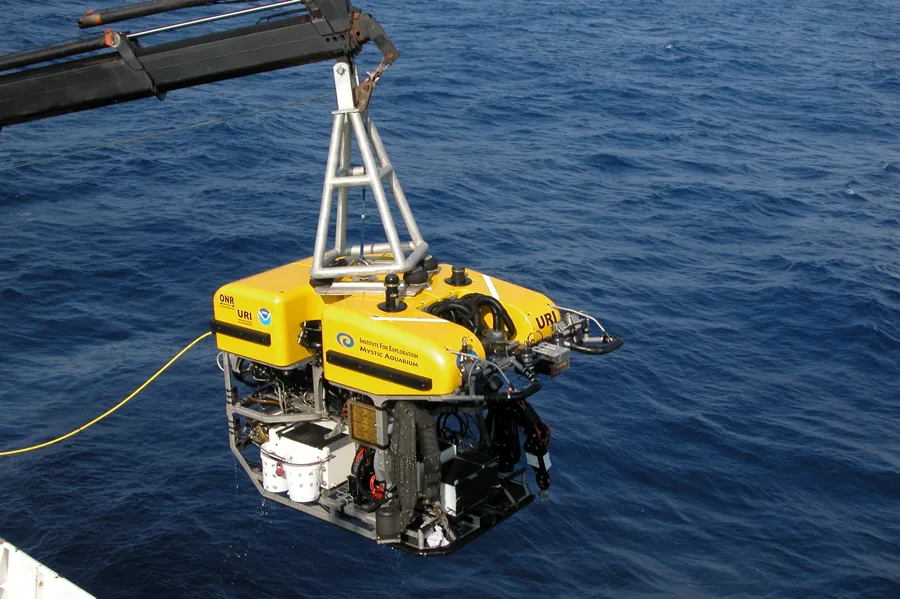
- Equipment cover: insurance for sonar, ROVs and other gear used in the water.
- Employer's liability and workers' accident schemes: protection for the people on board.
- Third-party liability: cover for harm to people or property outside the contract groups.
Equipment needs special attention. One P&I club, West of England, states that its normal P&I cover does not include damage to an object being towed, except under limited contractual conditions. It sells a separate towage extension. Survey gear is not a towed barge, but the lesson holds: ask the broker in writing how gear in the water is covered.
How knock-for-knock contracts share the risk
Most offshore support contracts use a knock-for-knock (KFK) regime. BIMCO describes its SUPPLYTIME 2017 charter in these terms. Each party carries loss or damage to its own property and injury or death of its own personnel, regardless of fault. Each party also indemnifies the other against those losses. A 2015 Clifford Chance briefing describes KFK clauses as industry standard in the maritime and offshore oil and gas sectors.
The P&I club Skuld lists three benefits. Exposure can be measured, double insurance is avoided and litigation falls. The alternative is a fault-based regime, where liability follows the degree of blame. Sharing losses then needs agreement or a court or arbitration ruling, which is slow and expensive.
Groups, subcontractors and other contractors on site
KFK works on "groups". Skuld recommends that each group include affiliates, subcontractors at every tier and their personnel. Subcontracts must be back-to-back, meaning they pass down the same allocation of risk. Otherwise the regime breaks somewhere in the chain.
Several contractors often work on the same site without a contract between them. A released contractors clause has the client cover its own contractors, but enforcement between contractors is difficult. A mutual hold harmless deed solves this by having every contractor sign one shared indemnity. It creates direct contracts, at the cost of more administration.
Where the contract and the policy can drift apart
Skuld explains that standard KFK liabilities fall within poolable P&I cover, which is the cover shared across the club system. Modified KFK does not. Examples are carve-outs, extra third-party liability or exclusions for gross negligence. These may need additional cover, which may not be available within P&I at all.
Skuld gives an example of a modified clause. The owner releases the charterer's group for personnel claims only up to USD 1,000,000 per incident. Above that amount, the direction of the release reverses.
West of England offers extended contractual liability cover for liabilities taken on voluntarily by contract. Its examples include waiving the right to limit liability and removing wreck at a contract party's request rather than an authority's. Another is naming others as co-assured with a waiver of subrogation, which is the insurer's right to recover its payout from another party. Clifford Chance advises parties not to accept liabilities beyond those they are entitled to limit. Where possible, they should get approval from their insurer or P&I club before agreeing to KFK terms.
Wording that causes disputes
Clifford Chance points to several weak spots. Parties should state clearly whether gross negligence, wilful misconduct and statutory liabilities fall inside the indemnity. It recommends avoiding the term "consequential loss" and naming the excluded losses instead, such as loss of profit or loss of use. Unclear wording is read against the party that drafted it.
Indemnities also have legal limits. In the Deepwater Horizon litigation, Transocean could not recover civil Clean Water Act fines from BP under its indemnity, because the fines were punitive. Local law decides these questions.
Professional risk: wrong data, wrong charts
The insurer ITIC offers PI cover for hydrographic surveyors. Its examples of claims include dataset errors, a port survey error that led a ship aground and a chart with a wrongly marked reef. ITIC also stresses that a surveyor can be sued without making a mistake, and defence costs can be high.
A hydrographer may owe a duty of care to anyone who reasonably relies on the chart, even without a contract. A 2007 ITIC article therefore recommends exclusion or limitation clauses in contracts, reports and charts. In ITIC's view, a cap should be no more than 10 times the fee and is commonly 5 times. Treat this as one insurer's opinion, not a market rule. Ownership and permitted use of the data matter too, as discussed in our article on survey data ownership and licensing contracts.
Indonesian requirements to check
Under Law 17/2008 on Shipping, article 203, a shipowner must remove a wreck that endangers navigation within 180 days of sinking and must insure the ship to secure this duty. Article 231 requires the owner or operator to insure liability for pollution from the ship. Article 204 requires a permit for underwater work. Article 41 sets insurance duties for water transport companies. Whether it applies to a survey vessel should be confirmed with legal counsel.
For personnel, Government Regulation 44/2015 requires employers to register workers with BPJS Ketenagakerjaan for work accident (JKK) and death (JKM) benefits. The regulation has since been amended, so check the current version and contribution rates.
What to ask a survey contractor
- Certificates for P&I, hull, PI and equipment cover, with co-assured naming and subrogation waivers where agreed.
- Confirmation that the broker or club has accepted the risk clauses as drafted.
- How subcontractors are covered, and proof that subcontracts are back-to-back.
- How towed or deployed gear is insured, in writing.
- BPJS Ketenagakerjaan registration for workers under Indonesian law, plus pollution and wreck removal cover for the vessel.
IMCA publishes survey contracting principles and survey support terms that include sections on insurance, indemnities, consequential loss and limitation of liability. Insurance and indemnity terms also affect price, as explained in our hydrographic survey cost breakdown.
Good offshore survey insurance starts with the contract: define the groups, keep KFK balanced, name excluded losses and separate physical from professional risk. Then have a broker and legal adviser confirm that every promise in the contract is backed by a policy. For planning a survey with these points settled early, see our marine geophysical survey services.
References
- BIMCO, "SUPPLYTIME 2017," BIMCO, 2017, https://www.bimco.org/contractual-affairs/bimco-contracts/contracts/supplytime-2017/
- Skuld, "Liability regimes in offshore contracts," Skuld, https://skuld.com/topics/legal/pi-and-defence/liability-regimes-in-offshore-contracts
- Clifford Chance, "Reviewing knock for knock indemnities: Risk allocation in maritime and offshore oil and gas contracts," Clifford Chance, 2015, https://cliffordchance.com/content/dam/cliffordchance/briefings/2015/10/reviewing-knock-for-knock-indemnities-risk-allocation-in-maritime-and-offshore-oil-and-gas-contracts.pdf
- West of England P&I Club, "Extended Contractual Liability Cover," West of England, https://www.westpandi.com/products/extended-covers/extended-contractual-liability-cover
- West of England P&I Club, "Towage Cover," West of England, https://www.westpandi.com/Products/extended-covers/Towage-Cover
- ITIC, "Hydrographic surveyors fact sheet," ITIC, 2026, https://www.itic-insure.com/fileadmin/uploads/itic/Documents/Factsheets/2026/Hydrographic_surveyors_fact_sheet_2026.pdf
- ITIC, "Professional indemnity insurance and the hydrographer," ITIC, 2007, https://itic-insure.com/our-publications/intermediary/professional-indemnity-insurance-and-the-hydrographer-2778
- IMCA, "IMCA survey work contracting principles," IMCA, https://www.imca-int.com/product/imca-survey-work-contracting-principles
- IMCA, "Terms and conditions for survey support services (IMCA LCIC 006 / S 007)," IMCA, https://www.imca-int.com/product/terms-and-conditions-for-survey-support-services
- Government of Indonesia, "Law No. 17 of 2008 on Shipping," JDIH Ministry of Finance, 2008, https://jdih.kemenkeu.go.id/fullText/2008/17TAHUN2008UU.htm
- Government of Indonesia, "Government Regulation No. 44 of 2015 on the JKK and JKM Programmes," peraturan.go.id, 2015, https://peraturan.go.id/files3/pp-no-44-tahun-2015_asli.pdf
Related Articles